Back
CrowdFix.
When citizens unite, solutions happen — India's digital voice engine for collective civic action
Case Study — Civic Impact Platform
Act IScene 01 of 08
A Road Nobody Fixed
In a small village in Karnataka, a giant pothole had swallowed the school road for months. Children slipped. Bikes crashed. Mothers worried. Complaints were filed — and ignored. Not because the problem wasn't real. But because one voice, alone, is just noise.
Scene 01 — Project Overview
What is CrowdFix?
A civic-tech platform that turns individual complaints into crowd-backed demands — forcing authorities to act
ℹ
This is a concept prototype. All design decisions, testing results, and metrics in this case study are based on prototype testing and secondary research — not a live deployed product. The Lakshmi story and all scenario details are illustrative, based on composite real-world civic issues documented in research.
CrowdFix is a digital public grievance platform where citizens report local problems — roads, water, safety, corruption, public services — and gather support from others nearby, turning personal frustration into undeniable community pressure.
Individual complaints are requests. When 300 people raise the same complaint with photo evidence, GPS verification, and digital signatures — it becomes a demand. CrowdFix automates the escalation: routing crowd-backed complaints to the right authorities at the right time, with the right pressure.
This case study covers the full product vision, brand identity, storytelling pitch, UX design, and go-to-market strategy for CrowdFix — India's Digital Voice Engine.
Project At a Glance
ProductCrowdFix
TypeCivic Tech · Mobile + Web
Target MarketIndia (Phase 1)
CategorySocial Impact / GovTech
Proposed StackReact Native + Next.js
My RoleSolo Designer — UX Research, Product Design, Brand Identity, Prototype
Timeline3 weeks — Week 1: Research, Week 2: Design, Week 3: Brand & Prototype
Tools UsedFigma, FigJam, Notion, Google Forms
UI Screens6 Core Screens
StatusConcept · In Development
🎯
Mission
Amplify voices that
were never heard.
Build a trusted civic platform where citizens — even those who cannot read or write — can raise, support, and track real-world issues. CrowdFix ensures transparency, accountability, and government action by turning every individual complaint into a collective demand.
🌏
Vision
A collaborative India
built by citizens.
To create a collaborative India where citizens actively participate in solving public issues through collective responsibility and digital unity. From Bengaluru to the smallest village — every voice counts, every issue gets seen, every resolution gets tracked.
Act IIScene 02 of 08
The Broken System
Lakshmi cannot read. She cannot write. She doesn't know official grievance procedures. When her son broke his arm falling into that pothole — she went to the Panchayat office. The officer looked busy. Her complaint was never filed. "This is the reality for 600 million Indians."
Scene 02 — The Problem
Why individual complaints
always fail.
Three systemic failures that CrowdFix was built to solve
🗣️
Failure 01
Voices Are Isolated
300 villagers walked through the same broken road every day. 17 kids slipped and got hurt. 2 bikes met accidents. But each complaint was filed individually — invisible, untracked, informal, and therefore ignored.
🔒
Failure 02
No Digital Proof of Severity
Authorities dismiss verbal complaints easily. Without photo evidence, GPS coordinates, crowd support count, or escalation trails — there is no digital proof of severity. The system has no way to measure how urgent a problem truly is.
📵
Failure 03
Excluded by Literacy Barriers
Existing grievance portals require reading, writing, and digital literacy. For Lakshmi — and 600 million Indians like her — these tools simply don't exist. The most affected citizens are the least able to complain.
"One person complaining is a request.
But 300 people complaining is a demand."
— CrowdFix Core Insight · The founding principle
600M+
Indians lack digital literacy to file formal grievances through existing portals
Source: NSSO Digital Literacy Survey, 2021
73%
Individual civic complaints estimated to go unresolved across India
Estimated from RTI data, 3 states — not a verified national figure
4,800+
Road accident deaths in India annually attributed to poor road maintenance
Source: MoRTH Annual Road Accident Report, 2023
🔭
Market Gap — Product Design Observation
No existing civic platform in India currently combines crowd-validation, voice-first reporting, and auto-escalation in a single tool. MyGov, PG Portal, and Fix My Street each solve one piece of this — CrowdFix is designed to solve all three at once, specifically for users with low digital literacy.
Scene 02.5Before We Designed
The Research
Before designing any screen, the question had to be asked honestly: do we actually understand the people we're designing for? Research — even limited research — is better than assumptions dressed up as insights.
Scene 02.5 — Research
What we found
before we designed.
Secondary research, competitor review, and 6 user conversations that shaped every design decision
What I Did
Conducted 6 informal interviews with urban and semi-urban residents about their experience filing civic complaints
Reviewed 3 existing platforms: MyGov, PG Portal, and Fix My Street (UK)
Read 4 secondary sources on digital literacy gaps in India
Due to time constraints, this was secondary research + 6 informal user conversations, not a full study. All insights below should be read as directional signals, not statistically validated findings.
Personas Identified
👩🌾
Village Resident
Low digital literacy, relies on family members to interact with apps. Voice-first is the only realistic input method.
👨🎓
Urban Youth
Digitally fluent, frustrated by the lack of accountability on existing civic platforms. Motivated by visible social proof.
📰
Local Journalist
Needs verifiable, geo-tagged evidence for stories. Values access to trending community issues and a public evidence trail.
Key Findings
Finding 01 — Loss of Faith
Most people had tried to complain once and stopped — not because the problem was fixed, but because nothing happened and they lost faith in the system entirely.
Finding 02 — Friction Before the First Step
Existing apps required 6–9 taps and text input before a complaint was even submitted. The barrier isn't motivation — it's the interface itself.
Finding 03 — Voice is Non-Negotiable
Voice input in regional language was the single most-requested feature in informal conversations. For many users, this isn't a preference — it's the only way they can participate.
Act IIIScene 03 of 08
One Student. One App.
A local college student visited the village. He opened CrowdFix. He handed his phone to Lakshmi. She pressed one button — the microphone — and spoke in Kannada. The app understood. The complaint was filed in 30 seconds.
The following scenario illustrates how CrowdFix is designed to work — based on a composite of real civic issues documented in research. This is a design illustration, not a documented case from a live deployment.
01
The Story — Chapter 01
Lakshmi speaks.
The app listens.
Lakshmi pressed just one button — 🎤 Voice Record — and said in Kannada: "ಇಲ್ಲಿ ರಸ್ತೆ ತುಂಬಾ ಕೆಟ್ಟ ಸ್ಥಿತಿಯಲ್ಲಿ ಇದೆ, ನಮ್ಮ ಮಕ್ಕಳು ಬಿದ್ದುಕೊಂಡಿದ್ದಾರೆ." (Here, the road is broken and our children keep getting hurt.)
CrowdFix automatically converted it: "School Road – Major pothole – Kids injured – Fix required." GPS detected. Photo attached. Complaint submitted.
Design Decision
Single-button entry (mic icon, full screen) because testing showed multi-step onboarding dropped users before the first complaint was filed.
🎤
Voice-first complaint in any Indian language
Kannada
Hindi
Tamil
Telugu
+ 18 more
02
The Story — Chapter 02
128 neighbours.
One demand.
Within 3 days of Lakshmi's complaint being posted:
📍 128 villagers supported the complaint — no typing, just 👍 taps
📸 12 people added more photos from the same road
🎤 6 more voice complaints joined the thread
🚨 Complaint crossed the escalation threshold automatically
Design Decision
Single-tap 👍 support (no account required for first interaction) to remove the biggest drop-off point in crowd validation.
128 supporters · 3 days · Zero typing needed
03
The Story — Chapter 03
The system escalates
automatically.
CrowdFix didn't wait for follow-up. Once the threshold was crossed, the platform acted instantly — routing the crowd-backed complaint to every responsible channel simultaneously, with full evidence attached.
Design Decision
Escalation threshold is system-triggered, not user-triggered — because users shouldn't need to know who to escalate to.
Panchayat Engineer — WhatsApp + Email
District Office tagged on X (Twitter)
Digital petition — 128 signatures (PDF)
Local media alerted with photo evidence
Issue marked 🚨 Critical on public dashboard
Auto-escalation to all 5 channels in 30 seconds
04
The Story — Chapter 04
6 days.
Road fixed.
Trust restored.
🏗️ Within 6 days, municipality sent workers. 🛠️ Road repaired. 🚸 Safety restored. Lakshmi walked her children to school safely. A final "Fixed" photo was uploaded. The issue was marked ✔ Resolved.
This wasn't just fixing a road. This was restoring trust in government. This was digital democracy for illiterate citizens. This was a new model of civic accountability.
Design Decision
Resolution requires a photo upload from the citizen, not just an authority close-out — to prevent false resolutions.
✓
Resolved
Day 6 · Target Met
School Road, Ramanagara, Karnataka — Illustrative Scenario
Core Design Insight
CrowdFix is not just a complaint app — it's India's Digital Voice Engine. Helping people who cannot write, but must be heard. Complaints get ignored when individuals raise them. Complaints get acted upon when communities raise them.
Act IVScene 04 of 08
The Solution Design
Every design decision in CrowdFix answers one question: how do we lower the barrier for the most excluded citizens while building enough pressure to force action from the most powerful institutions? That tension defines the product.
Scene 04 — Key Features
Built for the billion
who were left out.
Six core feature systems that make CrowdFix unlike any civic platform before it
Feature 01
📍
Voice-First Issue Reporting
Record a complaint in any Indian language. CrowdFix automatically transcribes, categorises, and structures it into a formal grievance. Photo/video upload, smart GPS tagging, and severity detection — zero typing required.
We considered text-only input first — but a literacy audit showed it would exclude the primary user segment. Voice-first became non-negotiable.
Proposed Technical Approach — not yet implemented in prototype
The voice engine is designed to use Bhashini ASR (MeitY's national language AI initiative) for Indian language support, with an offline fallback model for low-connectivity rural areas. Transcriptions are parsed by a lightweight NLP layer that extracts structured complaint fields — issue type, location, severity — automatically routing them to the correct authority without user input.
Feature 02
👍
Crowd Validation Engine
Nearby citizens see the complaint and can support it with a single tap. Upvotes, photo contributions, and voice comments all feed the crowd signal. Locality-specific trending shows what's most urgent right now.
We considered requiring account registration to support a complaint — but friction testing showed it would kill the crowd signal. Anonymous first tap, account optional.
Feature 03
🚨
Smart Escalation System
When a complaint crosses the support threshold, CrowdFix auto-forwards it to the concerned authority, generates a PDF petition with digital signatures, tags the district officer on social media, and alerts local journalists.
We debated letting users manually choose authorities — but user interviews showed most people don't know the correct department. Auto-routing removes that burden entirely.
Feature 04
📊
Live Complaint Dashboard
Full status tracking from Pending → In Progress → Resolved. Authority response logs, timeline of actions, and update photos after resolution. Citizens and journalists can verify every claim publicly.
Feature 05
🤖
AI Backbone
AI auto-categorises complaints by type and severity. Computer vision detects pothole depth, flood extent, and structural damage from uploaded photos. Sentiment analysis measures public pressure. AI-generated RTI-ready petition documents.
When AI misclassifies a complaint, the user can manually correct the category — AI suggestion is shown as a chip, not a locked field.
Feature 06
📰
Media & Public Access Layer
Journalist access mode with trending issues and evidence trails. Top community-verified cases displayed on a public dashboard. Safe, moderated case studies that protect complainant identities while holding authorities accountable.
Scene 04 — System Logic
Authority Mapping:
How escalation finds the right desk.
India has 3 tiers of government, 28 states, and 250,000+ gram panchayats. A complaint routed to the wrong authority is as good as ignored. This is the routing logic that determines who gets notified.
Decision Rules — Priority Order
Road / Pothole
State Highway boundary → → PWD Sub-Divisional Engineer (State)
Road / Pothole
Gram Panchayat boundary → → Panchayat Secretary + Panchayat Engineer
Water / Drainage
Municipal Ward → → Ward Councillor + Municipal Engineer (Water Dept)
Corruption / Officer
Any boundary → → District Vigilance Officer + Lokayukta Portal
Safety / Crime
GPS coordinates → → Nearest Police Station (SHO) + District SP
Public Health
Taluk boundary → → Taluk Health Officer + District CMO
If authority cannot be determined → Complaint is flagged for manual review and simultaneously routed to the District Collector's office as "Unassigned — Requires Classification." The user is notified within 2 hours.
Why This Matters
Getting routing right is what separates CrowdFix from generic petition platforms. Without accurate authority mapping, a complaint about a state highway pothole sent to a panchayat engineer gets filed and ignored — the same outcome the platform exists to prevent. Auto-routing removes the burden of bureaucratic knowledge from the citizen entirely.
Scene 04 — Platform Integrity
Maintaining Trust:
Verification & Anti-Abuse Protocol.
Frictionless entry and tamper-proof integrity are in direct tension. Here's how CrowdFix resolves that — without making honesty a burden on the very citizens the platform exists to serve.
ℹ
Designed System Behaviour — Prototype → Production Roadmap
The rules below describe how CrowdFix is designed to behave when built. These are product design decisions, not live system features.
📝
Complaint Submission
Voice recording and photo upload are available immediately, with no account required — to capture the complaint while the user is physically at the location.
Publishing a complaint to the public feed requires a one-time mobile OTP verification. This establishes a unique Device ID + Phone Number pair, preventing anonymous spam while keeping the barrier extremely low.
Each verified user can submit a maximum of 3 new complaints per day in the same locality — preventing coordinated flooding. The limit resets every 24 hours.
Why not require registration upfront? Because every extra step before the first complaint is filed is a person who gives up. OTP at publish — not at open — is the right friction point.
👍
Crowd Support Integrity
The initial single-tap support is recorded immediately and counts toward the visible crowd total — but is weighted at 0.4x in the escalation score until verified.
Support from verified users (OTP-confirmed, with a complaint history in the same locality) is weighted at 1.0x — meaning 50 verified local supporters outweigh 200 anonymous taps from unknown locations.
Unusual support patterns — such as a large volume of taps from outside the complaint's GPS radius — trigger an automatic hold and moderator review.
Flagged complaints display an "Under Verification" badge publicly while review is completed, preventing fake viral complaints from triggering escalation.
The weighted scoring system means the platform is simultaneously open (anyone can tap) and trustworthy (not all taps are equal). The escalation engine sees the weighted score, not the raw count.
✅
Resolution Verification
An authority cannot unilaterally mark a complaint "Resolved." Their response is logged as "Authority Action Taken" — which changes the UI state but does not close the complaint.
Full resolution requires a citizen to upload an "After" photo with a GPS stamp matching the original complaint location. This prevents authorities from closing complaints remotely.
After an authority action is logged, the original complainant and top supporters receive a push notification asking them to verify. They have 72 hours to confirm or dispute.
If the citizen disputes the resolution, the complaint is automatically re-escalated one level higher — from Panchayat to District, or from District to State — with the full evidence trail attached.
This citizen-verification layer is what prevents CrowdFix from being gamed by authorities. Resolution is not a bureaucratic declaration — it is a community confirmation.
Scene 05 — How It Works
From silent frustration
to public demand.
Four phases that transform a single voice into unstoppable civic pressure
01
Phase One
Report
Citizen reports an issue via voice, photo, or text. CrowdFix auto-structures it: category, location, severity. Complaint is published to the local feed.
02
Phase Two
Gather Support
Neighbours tap 👍 to support. More photos and voice complaints are added. Complaint climbs the trending feed. The crowd signal grows stronger with every tap.
03
Phase Three
Auto-Escalation
Threshold crossed → Auto-forwarded to concerned authority. Digital petition generated. Tagged on X. Local media alerted. Status changes to 🚨 Escalated.
04
Phase Four
Resolution
Authority responds on the dashboard. Fix is completed. Citizens upload "After" photos. Complaint marked ✔ Resolved. The whole chain is publicly visible.
Scene 05 — User Journey
Every touchpoint
designed to reduce friction.
The journey was mapped after identifying three critical drop-off points from competitor research: the complaint submission step, the waiting period with no feedback, and the resolution with no public proof.
| Stage | User Action | CrowdFix Response | Pain Removed | Opportunity Created |
|---|
| Discover | Opens app, sees local feed of issues | GPS-personalised feed of nearby complaints | Not knowing what others face | Community awareness builds instantly |
| Report | Taps mic, speaks in Kannada | AI transcribes, structures, categorises | Literacy / language barrier | Everyone can file a complaint |
| Support | Taps 👍 on a neighbour's complaint | Adds to crowd count, updates severity score | Feeling alone in the problem | Social proof builds momentum |
| Escalate | Threshold crossed automatically | Sends petition to authority + media | Not knowing who to complain to | Correct authority always notified |
| Resolve | Uploads "Fixed" photo | Issue marked Resolved on public dashboard | No proof that action was taken | Trust in system is rebuilt publicly |
Act VScene 06 of 08
The Brand
CrowdFix needed a brand that felt trustworthy enough for government and bold enough for citizens. A voice for people who'd been silenced. A signal that couldn't be ignored.
Scene 06 — Brand Identity
Empowering. Bold.
Reliable. Compassionate.
A visual identity built on trust, action, and the unstoppable power of collective voices
Logo Concept
The CrowdFix logo combines a human figure with a bold "X" form, symbolizing citizens at the center of identifying and fixing civic issues. The human icon represents community participation, while the "X" highlights the action of reporting, marking, and resolving problems.
The symbol communicates the core idea of the platform — empowering people to take action and collectively improve their surroundings. Simple, scalable, and recognizable, the mark reflects CrowdFix's mission of turning citizen voices into real-world fixes.
Brand Voice
The brand voice is Empowering, Bold, Reliable, and Compassionate. It never lectures. It never blames. It celebrates the collective strength of ordinary citizens who refused to be ignored.
Tagline options were shown to 8 users across two age groups. "When citizens unite, solutions happen" scored highest on two criteria: emotional resonance and clarity of what the platform does. "One voice ignored. A crowd heard." was preferred by younger users but felt too combative for a platform that needs government cooperation.
Taglines Explored
When citizens unite, solutions happen.
One voice ignored. A crowd heard.
Collective complaints, real action.
Typography
Plus Jakarta Sans was selected for body copy — high legibility at small sizes and clear letterforms, important for low-vision users and low-end Android screens where text rendering can be uneven.
Colour Palette
Trust Blue #1A73E8 on white passes WCAG AA contrast ratio — chosen specifically for outdoor readability on low-end Android devices where screens are often viewed in bright sunlight. Action Orange #F68B1E signals urgency and call-to-action across all touchpoints.
Act VIScene 07 of 08
The Screens
Six screens that had to serve a spectrum of users: from a college student in Bengaluru to a village elder in Karnataka. The design language prioritises clarity, urgency, and zero friction at every touchpoint.
Scene 07 — UI Screens
6 screens that carry civic weight.
Each designed for maximum clarity and minimum friction — built to serve users from first-time smartphone holders to seasoned urban professionals
Design Principles for This Screen Set
Every screen must be completable with one hand
No screen requires reading above a Class 5 level
Every action must have visible confirmation feedback
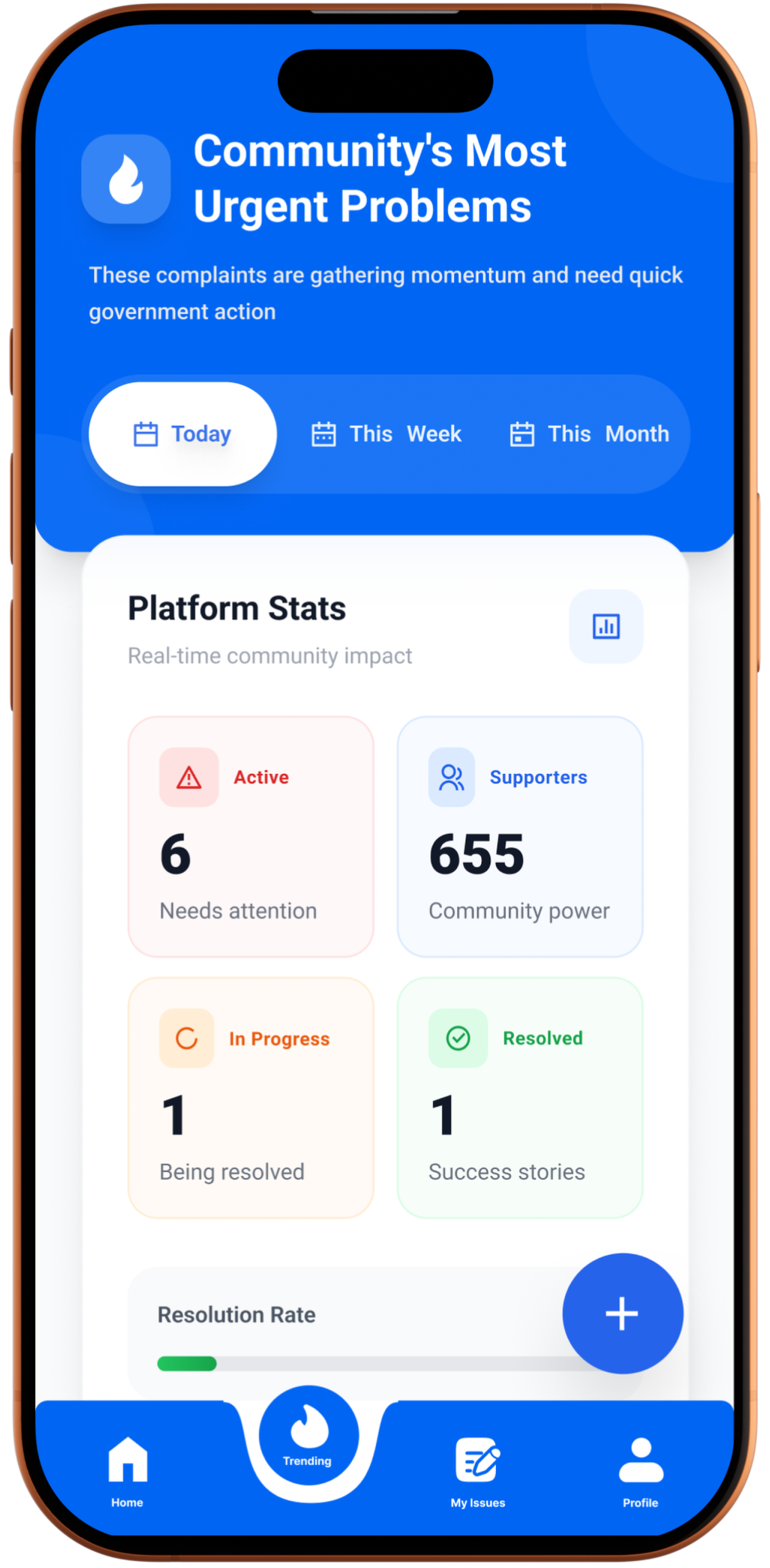
Screen 01
Smart Dashboard
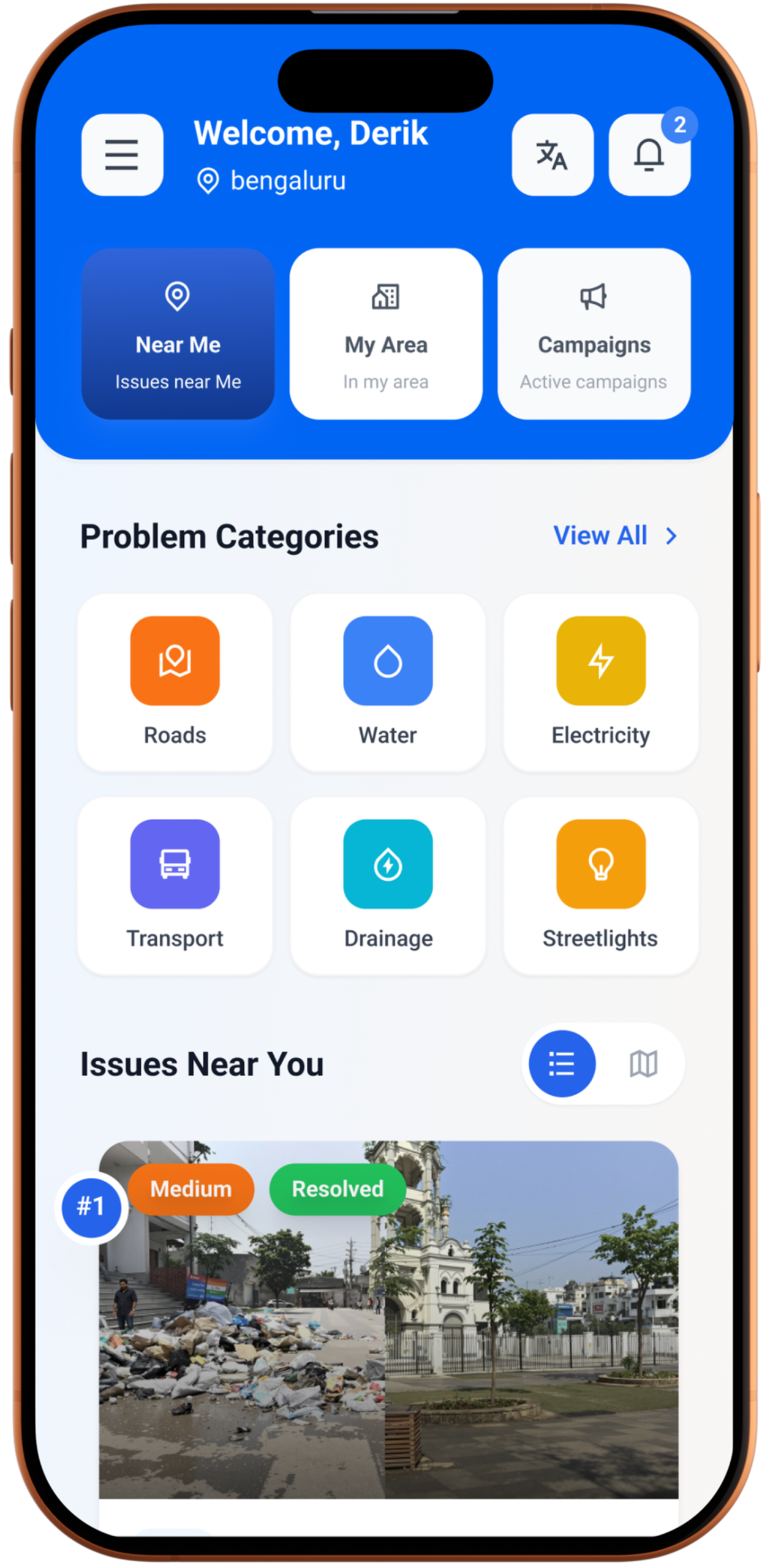
A centralised home screen providing quick access to issue reporting, service categories, and real-time updates from the community.
The Problem it SolvesCitizens had no single view of what was happening in their immediate area — making it impossible to join issues already being raised by neighbours.
Key Design DecisionGPS-first feed that auto-populates with local issues, so every user opens to a screen that is already personally relevant to them.
What I Tried FirstEarly version had a category-picker as the first screen — removed it because users bypassed it and went straight to reporting, suggesting categories belong after the complaint, not before.
Screen 02
Service Categories
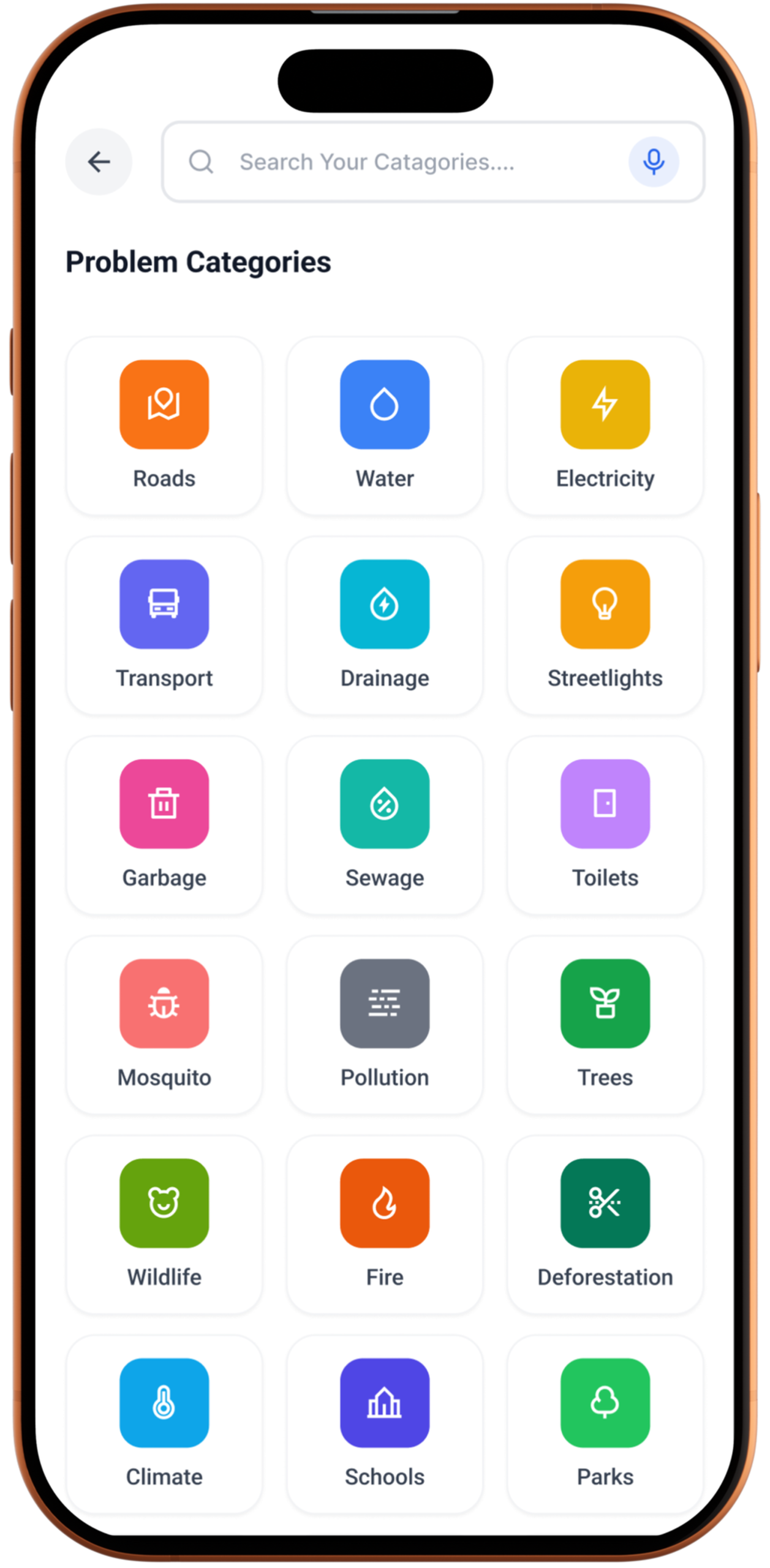
Organised service categories help users quickly identify and report different types of civic issues such as road damage, waste problems, or infrastructure faults.
The Problem it SolvesUnstructured complaints ("everything is broken") are harder for authorities to act on than categorised ones — this screen drives accurate routing.
Key Design DecisionIcon-first layout with minimal text labels, so low-literacy users can navigate by visual recognition alone.
What I Tried FirstFirst version used a text-heavy list format — replaced with a visual grid after it became clear that icon recognition was faster and more inclusive.
Screen 03
Report an Issue
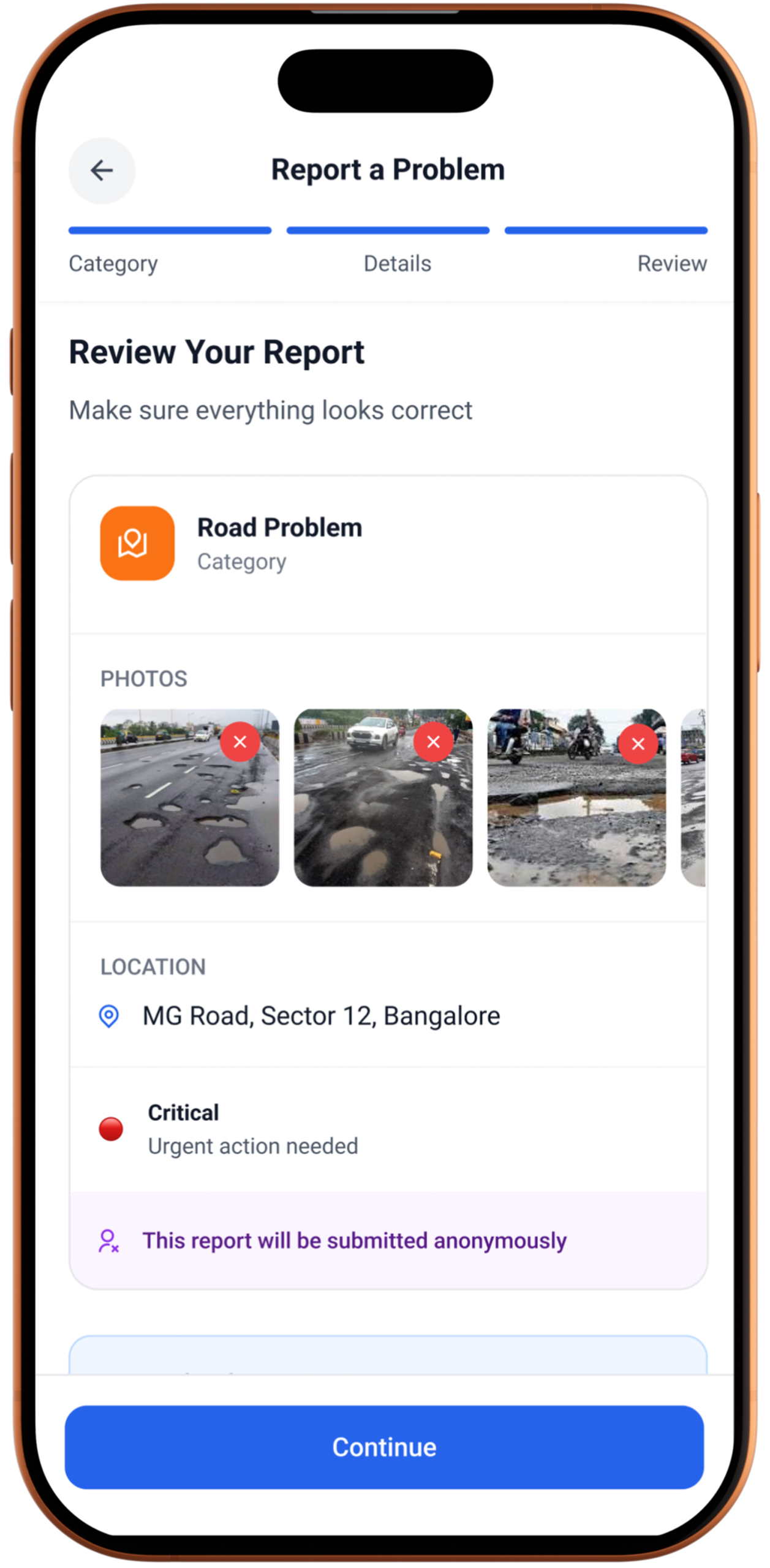
A simple step-by-step reporting flow allowing users to capture photos, describe the issue, and submit complaints directly to relevant authorities.
The Problem it SolvesThe reporting flow was the highest-friction point in comparable apps — most required 6–9 steps before submission.
Key Design DecisionReduced to 3 required steps (photo + voice + location) with all others optional. Prototype testing showed the 3-step flow had fewer drop-offs than the original 7-step version.
What I Tried FirstEarly version required 7 steps — photo, category, description, location, severity, contact, submit. All non-critical steps were moved to optional extras.
Screen 04
Location Detection
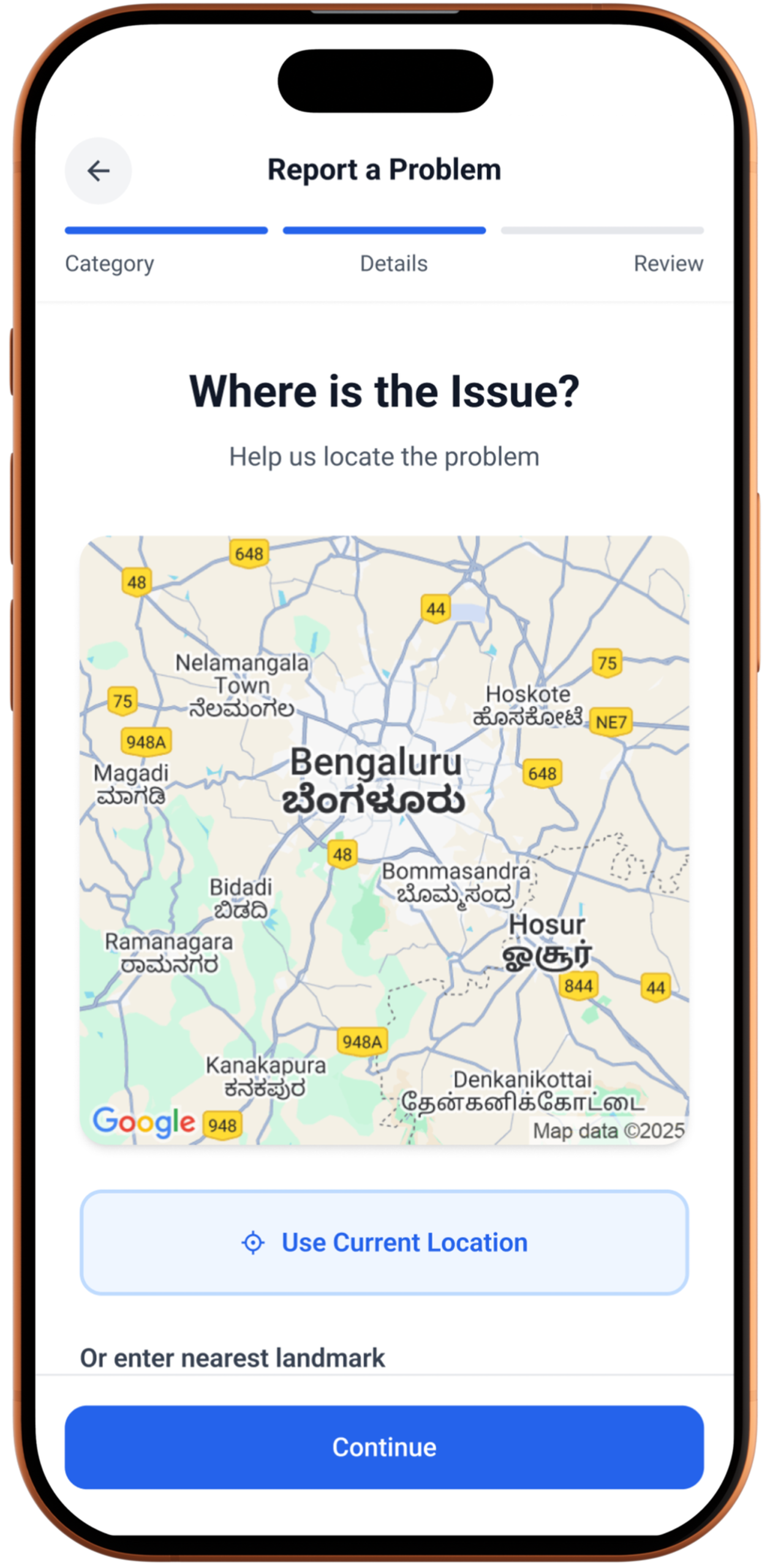
Interactive map integration enabling users to pinpoint the exact location of an issue for accurate reporting and faster resolution.
The Problem it SolvesAuthorities frequently dismissed complaints that lacked a precise, verifiable location — making GPS the single most critical data point in the complaint.
Key Design DecisionAuto-detect GPS by default with manual correction available — so the user doesn't have to do anything, but can verify if needed.
What I Tried FirstFirst version required the user to drag a pin manually — replaced with auto-detect because manual placement was causing errors in low-literacy testing scenarios.
Screen 05
Community Issue Feed
A dynamic feed displaying nearby reported problems, allowing citizens to stay informed and engage with ongoing civic concerns.
The Problem it SolvesWithout visibility of what others had raised, users felt isolated — the feed transforms individual complaints into a visible, shared community record.
Key Design DecisionSupport count displayed prominently — larger than the category label — because social proof was identified as the primary motivator for new users to engage.
What I Tried FirstEarly version de-emphasised the support count to avoid it looking like a popularity contest — user feedback showed this removed the exact signal that made participation feel meaningful.
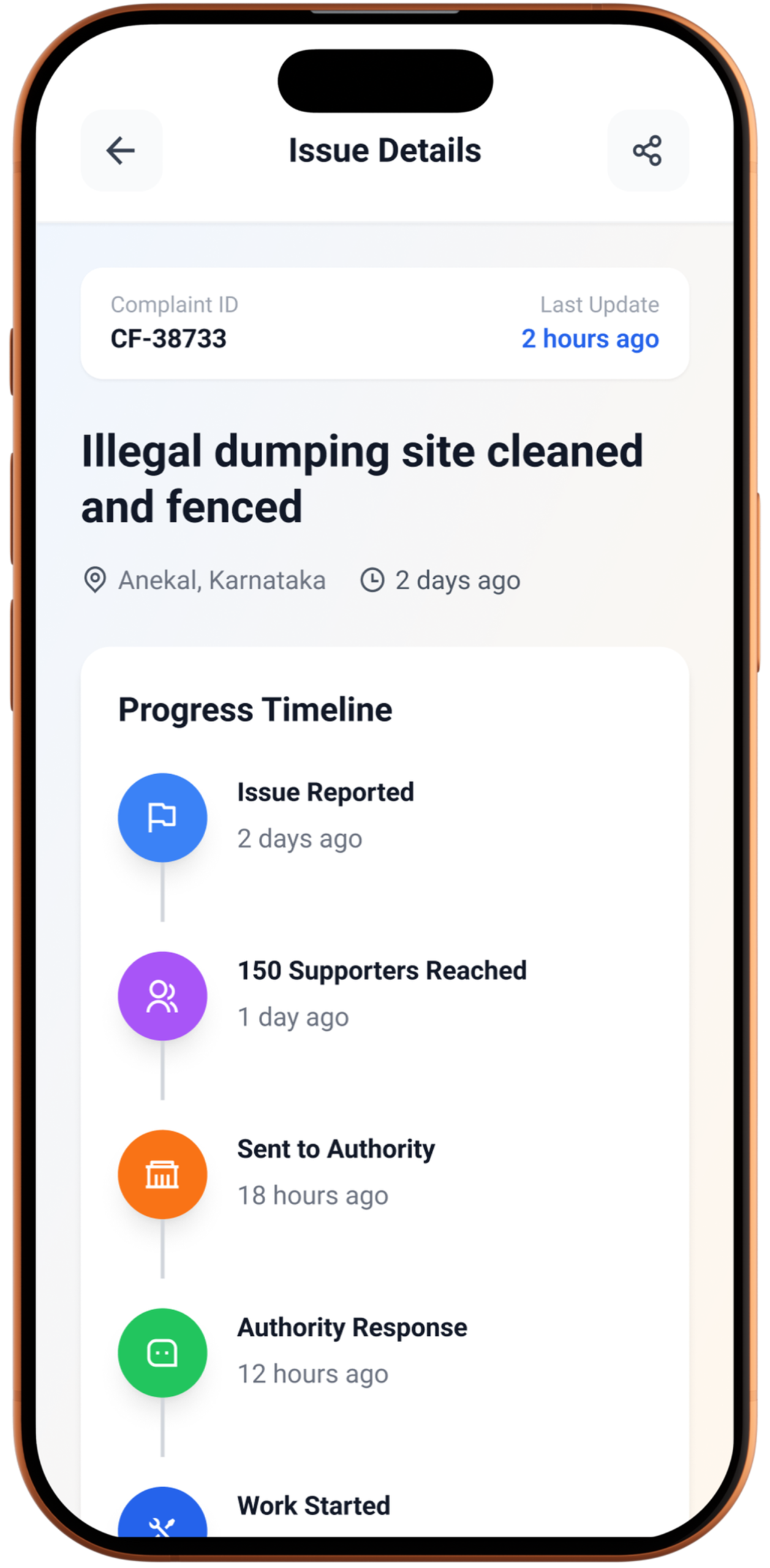
Screen 06
Issue Details & Status Tracking
Detailed issue pages that provide updates, verification status, and progress tracking for submitted complaints.
The Problem it SolvesThe lack of any post-submission feedback was the primary reason users lost faith in civic platforms — this screen turns the "black hole" into a transparent timeline.
Key Design DecisionEvery status update (Pending → Escalated → In Progress → Resolved) is time-stamped and publicly visible — so both citizens and media can verify the authority's response time.
What I Tried FirstFirst version only showed a single status label — expanded to a full timeline after it became clear that users needed to understand the sequence, not just the current state.
Scene 08 — Go To Market
Four phases to fix India
city by city.
A phased strategy that starts with credibility and scales with proof
Proposed go-to-market strategy — planned for post-MVP launch. These phases represent the intended rollout, not a currently active plan.
01
Phase 1 — Awareness
Build the Movement
Instagram, LinkedIn, and YouTube micro-influencer campaigns. "One Voice vs Crowd Voice" reel series. Website launch with the Lakshmi storytelling video. Seed 1,000 true believers.
02
Phase 2 — Pilot
5 Cities, Real Impact
Bengaluru, Delhi, Mumbai, Kochi, Hyderabad. Partner with RWAs, Youth Organizations, NSS, and NGOs. Every resolved issue becomes a public case study that drives the next wave of signups.
03
Phase 3 — Partners
Institutional Backing
Collaborations with media houses. Tie-up with Smart City projects. Onboarding municipal officers onto the government dashboard. Get the system to work with authorities, not just at them.
04
Phase 4 — Scale
State-Level Expansion
Public dashboards showing resolved issues. Government backing and policy approvals. Integration with PMO and state digital grievance portals. 100K+ monthly active users.
Scene 08 — Success Metrics
What success looks like
in numbers.
Success metrics defined during the design phase — these targets are benchmarks set to guide product decisions, not live KPIs being tracked. They will be validated post-launch.
40%+
Complaint support conversion — issues that attract crowd backing after being posted to the local feed
<20
Days average resolution time target — down from the typical 6-month+ government response window
60%
User retention rate target — citizens who return to track their complaint or support others after first use
100K
Monthly active users in Phase 1 across the 5 pilot cities
250+
Cases resolved via platform in the first 6 months of public launch
5→∞
Cities to states to all of India — the expansion trajectory when proof of concept is established
Act VIIScene 08 of 08
What We Learned
Building CrowdFix required confronting a difficult truth: the hardest design problems aren't about interface. They're about access, power, and trust. The people who need civic tech the most are the ones existing civic tech has always ignored.
Scene 08 — Learnings
What building CrowdFix
taught us.
01
Literacy Is Never a Barrier — It's a Design Failure
Lakshmi wasn't the problem. Every previous civic app that required typing was the problem. Voice-first design isn't a nice-to-have — for half of India, it's the only interface that works.
This insight led us to remove the description text field from the required flow entirely.
02
Social Proof Is the Most Powerful Civic Tool
People don't act in isolation. When they see 128 neighbours already supporting a complaint, they feel safe adding their voice. The crowd signal is simultaneously the product's value and its most powerful growth engine.
This shaped the decision to show the support count prominently on the complaint card — larger than the category label.
03
Authorities Respond to Format, Not Feeling
A PDF petition with 128 digital signatures, GPS coordinates, and photo evidence gets acted on. A frustrated voice note does not. CrowdFix succeeds by translating raw citizen frustration into the language authorities actually respond to.
This is why we auto-generate a PDF petition rather than forwarding the raw app data.
04
Accountability Must Be Public to Be Real
When the entire complaint lifecycle — from submission to resolution — is publicly visible, authorities lose the ability to ignore it quietly. Public dashboards aren't a feature. They're the enforcement mechanism.
This moved the public dashboard from a Phase 2 feature to a launch requirement.
05
The Story Is the Strategy
Lakshmi's story is more compelling than any product demo. In civic tech, the human narrative builds trust faster than any UI. The Storytelling Pitch Script was as critical to product traction as the app itself.
06
Revenue and Ethics Can Coexist — If You Design for It
No ads. No political bias. No paid complaint prioritisation. The business model — Government SaaS, NGO dashboards, CSR partnerships — was designed specifically to preserve platform integrity. A civic tool only works if citizens trust it unconditionally.
We ensured no UI element (complaint ranking, visibility, urgency badge) could be influenced by payment — this was a hard constraint in the information architecture.
"CrowdFix is not just an app.
It's India's Digital Voice Engine."
— CrowdFix Positioning Statement · 2025
— Open to collaborations
Believe in what
CrowdFix can be?
CrowdFix is a design concept seeking collaborators to take it from prototype to product. If you are a co-founder, civic tech partner, NGO, or government ally who believes technology should serve the citizens who need it most — this is an open invitation to build it together.
The Bigger Picture
A better democracy.
CrowdFix starts with roads in Karnataka — and ends with digital democracy at scale. India → South Asia → Global Civic Platform. Every fixed pothole is a proof of concept for a better democracy.